
Archive Record
Images
Metadata
Catalog Number |
21.3.150 |
Object Name |
Folder, File |
Scope & Content |
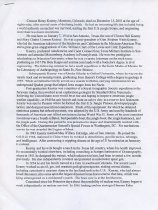
A file folder of Cresson H. Kearny obituaries and an article from Human Events, July 8, 1972. Will Soviet Civil Defense Undermine SALT? 1. Cresson Henry Kearny, Montrose, Colorado, died on December 18, 2003 at the age of eighty-nine, after several years of declining health. He had an interesting life that included being a world authority on nuclear war survival, starting the first U.S. jungle troops, and originating more than two dozen inventions. He was born on January 7, 1914 in San Antonio, Texas, the son of Clinton Hall Kearny and Mary Chabot Cresson Kearny. He was a great-grandson of Gen. Stephen Watts Kearny, who led he American takeover of the Southwest and California in the Mexican-American War, and a great-great-stepgrandson of Gen. William Clark of the Lewis and Clark Expedition. Kearny graduated valedictorian and Cadet Colonel from Texas Military Institute in San Antonio and attended Mercersburg Academy in Pennsylvania. He won two prestigious scholarships to Princeton University, where he was a varsity letterman on the track team, graduated in 1937 Phi Beta Kappa and summa cum laude with a bachelor's degree in civil engineering. The following summer he led a small expedition in the Sierra Madre of Mexico for the Laboratory of Anthropology in Santa Fe, New Mexico. Subsequently Kearny was a Rhodes Scholar to Oxford University, where he was on the varsity track and swimming teams, graduating from Queen's College with a degree in geology in 1939. While at Oxford he briefly served as a courier to Berlin, carrying information for an underground Quaker group hat helped Jews escape from the Nazis. Post-graduation Kearny was a member of a Royal Geographic Society expedition in the Peruvian Andes, then worked as an exploration geologist for Standard Oil in Venezuela. Believing the United States soon would be at war and hoping to improve American jungle warfare capability, in 1940 he quit his job and went on active duty as a reserve first lieutenant. Kearny was sent to Panama where he formed the first U.S. Jungle Platoon, developed jungle tactics, and designed specialized equipment. Much of his equipment, for which he obtained numerous patents but refused payment, was adopted by the U.S. Army and used by hundreds of thousands of American and Allied servicemen during World War II. Some of his most important inventions were a breath-inflated, backpackable boat, the jungle boot, the jungle hammock, and the jungle pack. During this period he was promoted to major and intermittently worked with the Office of the Quartermaster General's Special Forces in Washington, DC. For meritorious service he was awarded the Legion of Merit. In 1943 Kearny married May Willacy Eskridge, also of San Antonio. He joined the O.S.S. in 1944, stationed in China where he worked in demolitions, guerrilla tactics, sabotage, and intelligence. After contracting a crippling disease at the age of 31 he retired as an honorary lt. colonel. Kearny and his wife bought a ranch in the Texas hill country, where his health improved. He occasionally worked elsewhere, including consulting at Scripps Institution of Oceanography, where in 1951 he designed the wetsuit, which unknown to him, had been invented a few months previously. He also independently invented and patented and underwater spear gun. In 1954 he and his family moved to a farm in southwest Colorado. For several years Kearny worked as an oil, gas, and uranium, geologist/prospector, staking several claims, including a productive uranium claim in the last land rush in the U.S. Kearny, who had always loved dinosaurs, also came upon the largest dinosaur bone discovered at that time, which was lying unrecognized on a rockhound's porch. The bone now is at the Smithsonian. Concerned since his Princeton days about the possibility of nuclear war, Kearny began to work independently on nuclear survival. In 1961 leading nuclear strategist Herman Kahn recruited him to join the Hudson Institute, where Kearny worked on nuclear defense issues. Due to his expertise, he met Charles Lindbergh, whom Kearny advised on building a blast shelter. In 1964 Nobel Laureate Dr. Eugene Wigner asked Kearny to join the Civil Defense Project which Wigner was forming at Oak Ridge National Laboratory. At ORNL Kearny developed shelters and devices which people can make to improve their chances of surviving a nuclear conflict. His most important invention was the Kearny Fallout Meter, a highly reliable radiation meter made of materials commonly found in homes. His book Nuclear War Survival Skills, known as "the Bible of Civil Defense," includes instructions and survival advice. By the mid-1990s over 600,000 copies had been sold, with translations into Hebrew, Chinese, and other languages. Kearny copyrighted he book with the condition that the book could be reproduced by anyone, and renounced any royalty payments. The book is available on the Internet. He also wrote numerous publications on a variety of defense topics. Kearny took occasional leave to work on other projects. From 1967-1968, given the civilian equivalent of a four-star general's rank, he worked in Viet Nam with the Science Advisor to Generals Westmoreland and Abrams, improving infantrymen's equipment. He also developed simple measured to counteract Fuel-Air Explosives and was an expert on counterinsurgency. At a Defense Advance Research Project Agency Symposium in 1968, the director started his opening address that he "had not specialized in counterinsurgency work, but had studied the writing of leading authorities, including Mao Tse-tung, Ho Chi Minh, Che Guevara, and Cresson Kearny" - which Kearny found amusing. In 1970 he advised the Israeli on civil defense. For his defense work, in 1972 Kearny was awarded the Decoration for Distinguished Civilian Service, the United States highest civilian medal. In 1979 Kearny retired from ORNL, partly to be at liberty to speak more freely against American defense policies, especially "Mutual Assured Destruction," and inadequate nuclear civil defense preparation. In 1981 Kearny was invited to China to advise on civil defense. During the 1991 Gulf War he recruited citizens across America to make hundreds of thousands of protective plastic rifle bags, which the military had neglected to provide, and send them to soldiers to prevent sand from jamming their M-16s. In later years Kearny summarized his jungle expertise in Jungle Snafus...and Remedies, which is used by units of the U.S. Special Forces as a training textbook. In 1996 Kearny was presented with the Edward Teller Award for the Defense of Freedom "For his independent and ingenious contributions to the great problem of survival." Kearny's intelligence, creativity, persistence, and dedication to human survival were appreciated by his peers and earned the admiration and love of his family. He lived a full and productive life, and had a long, loving marriage and a large and close family. 2. Memorial service pamphlet for Cresson H. Kearny 3. A letter from Dr. Richard J. Stein to Ms. Adelia Kearny, dated January 12, 2004, offering his condolence and some information on Cresson Kearny. 4. A print of the Los Angeles Times website, titled Cresson H. Kearny, 89; Wrote Manual on Nuclear War Survival 5. A print of the San Antonio Express News obituary website page, dated 1/10/2004 and detailing Cresson H. Kearny's life and death. 6. A print of Legacy.com, dated January 10, 2004 and detailing Cresson H. Kearny's death and accomplishments. 7. Homeland Security Weekly, Jan. 5, 2004, Volume 3 Issue 01, in memory of Cresson H. Kearny. 8. The American Oxonian, Fall 2005, Volume XCII, Number 4, featuring Cresson H. Kearny in the "In Memoriam" section (p. 387) 9. The New York Times Obituaries page, January 12, 2004, titled Cresson Kearny, Expert on Nuclear Survival, Dies at 89 10. The Santa Fe New Mexican, January 2, 2004, titled Nuclear War Survival author Cresson Henry Kearny dies 11. Rocky Mountain News, January 3, 2004, obituary page, titled Cresson Kearny wrote about nuclear survival 12. Albuquerque Journal, February 14, 2004, titled Cresson Kearny: Engineer Decried Nuclear War 13. San Francisco Chronicle obituary page, January 6, 2004, titled Cresson Kearny - nuclear war survival expert 14. Montrose Daily Press obituary page, January 2, 2004, titled Cresson Henry Kearny: Jan. 7, 1914 - Dec 18, 2003 15. The Oak Ridger obituary page, January 7 ,2004, titled Cresson Henry Kearny; Former Oak Ridge resident 16. San Antonio Express-News, January 10, 2004, titled Former San Antonian wrote book on nuclear survival 17. a. Cresson Henry Kearny, 1914 - 2003 b. Journal of Civil Defense: 'We Got Him' - Bremer Announces Saddamn's Capture c. Strategic Insight: Countering the al-Qaeda WMD Threat 18. Battlelines: A Bimonthly Newsletter of the San Pasqual Battlefield Volunteer Association, March/April 2004, In Memoriam: Cresson H. Kearny 19. Los Angeles Time, January 7, 2004 obituary page, titled Cresson Kearny, 89; Wrote Manual on Nuclear War Survival 20. Access to Energy, December 2003, titled Cresson Kearny |
Catalog type |
Archive |
Creator |
Cresson H. Kearny |
Title |
Cresson H. Kearny Obituary File |
Collection |
Cresson H. Kearny Collection |